The Letter that Solved Nothing
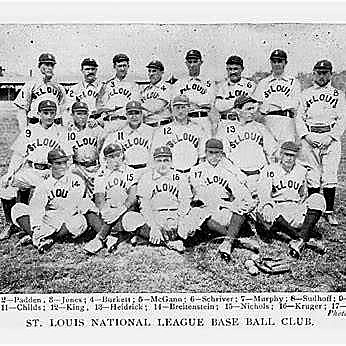
St. Louis Cardinals, 1900
On the evening of October 16, 1900, Frank De Haas Robison, President of the St. Louis Cardinals, decided that what his baseball club needed most was a letter.
Not a meeting. Not a quiet word in the club house. Not even a conversation about money or contracts or next year’s pitching rotation. Just a letter.
And not merely a letter just to his players.
He gave it to the newspapers too.
It was the sort of letter that felt as though it had been drafting itself all summer. The Cardinals had finished tied for fifth place—a club built to contend and stocked, at no small expense, with recognized talent. Robison and his partners had spent $30,000 assembling what they believed was a first-division team. What they received in return were sixty-five wins, seventy-five losses, and a second-division finish.
There was nothing surprising about Robison’s displeasure. Owners who spent that much generally expect more than a .464 winning percentage. What startled observers was not that he was angry, but that he chose to make his anger public—and personal. The letter blamed the club’s disappointing finish on eleven players who, Robison alleged, drank too much, kept poor hours, and gambled constantly. These were not fringe men. The group included stars such as Cy Young, Bobby Wallace, and Lou Criger.
The team’s losses, however, were not confined to the standings. The season had been a financial loss. “Their failure to make good and land the team in anything like a respectable position has cost Mr. Becker, my brother and myself a lot of money,” Robison wrote. “We are losers, good losers, on the season, exactly how much I do not care to state.”
Perhaps that helps explain what happened next. Instead of receiving their final two weeks’ pay, most of the players were handed notices reserving them for the 1901 season. They were informed that none had lived up to the terms of their contracts, that new agreements would be forthcoming, and that next year’s salaries would reflect this year’s performance, meaning salary reductions across the board. The club had paid them in full through October 1 and would pay them through October 15 as required, but the players would have to wait.
In other words, obligations had been met. Expectations had not.
Of the fifteen men who finished the season wearing a St. Louis uniform in 1900, four escaped public censure: John McGraw, Wilbert Robinson, Jesse Burkett, and Patsy Donovan. The rest received copies of the letter. And among those, one man in particular absorbed Robison’s full attention—Emmett Heidrick.
Heidrick had been a promising outfielder earning $1,500 in 1899. His play that season persuaded manager Patsy Tebeau that he deserved a raise. Robison was prepared to offer $1,800. Heidrick countered with $2,400—the limit—or he would spend the summer at his father’s sawmill in Wisconsin. Tebeau advised Robison to concede. Robison did.
It did not, in Robison’s view, pay dividends.
By midseason, Heidrick had appeared in only about twenty of the Cardinals’ first seventy games, sidelined by what was described as a “Charley horse.” Filling in was twenty-two-year-old Mike Donlin, a player as gifted at attracting trouble as he was at attracting attention. When Donlin’s face was cut in a saloon brawl, St. Louis found itself shorthanded and, increasingly, outmatched.
Around this time, Robison began hearing that Heidrick was moving about quite comfortably. The injury, he was told, might not have been as debilitating as advertised. “This I realized in time to be the truth,” Robison later explained, “and the day that Tebeau returned with the club I told him to inform Heidrick that for each day he remained out of the game it would cost him, and not the club.”
The next day Heidrick resumed his place in center field.
For Robison, that settled the matter. “I have regretted more than once that this young man didn’t leave us last spring and return to his father’s sawmill,” he said. “To him and to him alone, I blame the loss of third, or even a higher position in the race.”
It was a tidy explanation: a single culprit for a season gone wrong.
Robison’s sweeping charges, however, didn’t seem completely fair. It was true that the team had not performed as well as expected and at times there appeared to be a feeling of complete indifference among the players as to whether they won or lost. A few would give their best, while others only did as much as needed. But not everyone agreed that the blame lay solely in the clubhouse.
The St. Louis Globe-Democrat offered a different diagnosis. Robison, it suggested, was partially to blame, having set a bad example. “He was seldom in St. Louis, paid little attention to his players so far as appearances went, and the players, thinking he didn’t care, soon forgot to care themselves.” Ballplayers, the paper argued, required constant oversight. Without it, they drifted. Had management remained present and corrected the first signs of indifference, there might now be money in the treasury and smiles among the stockholders instead of unavailing complaints.
As matters stood, the players faced a simple choice: sign reduced contracts or remain out of the game.
Cutting salaries and publicly humiliating the players didn’t seem like the best strategy to motivate the players and win loyalty. More likely was that the players would sign for what they could get and continue to play the same type of indifferent ball that management complained about.
So in the end, Robison’s letter accomplished nothing—or at least nothing positive.