October 1900. Baltimore.
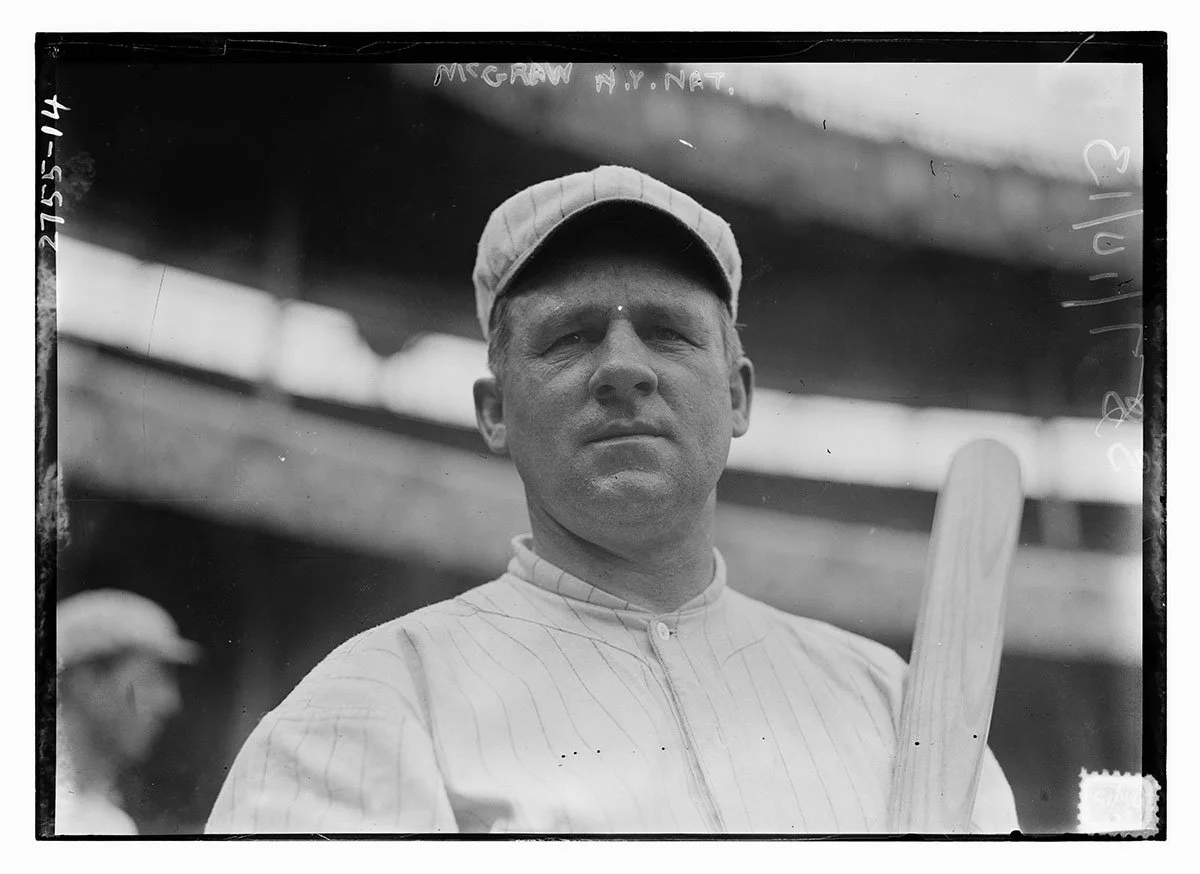
John McGraw
The 1900 season had ended for St. Louis the way most seasons end when expectations run ahead of reality. The Cardinals began the season expected to be a contender. By October they’d drifted to a .464 winning percentage—sixty-five wins, seventy-five losses—tied with Chicago at the top of the second division, which was another way of saying nowhere near the front.
The standings were settled. The money spent. What remained unsettled was John McGraw’s future.
He’d arrived from Brooklyn the previous spring, bringing with him his reputation, his temperament, and a certain volatility that depending on the day promised either brilliance or combustion. But after a long and disappointing season, his contract expired at 4:45 p.m. on October 14, 1900. When asked where he would be in 1901, McGraw did what he often did best: he answered without answering.
“That remains to be seen,” he said. “I have spent a pleasant season in St. Louis. The Robisons and the fans have treated me most kindly and I would be an ungrateful wretch if I registered a complaint.”
It was the sort of statement that sounds gracious while keeping every door open.
But McGraw wasn’t prepared to make any commitments. “The present off-season is going to be a most important one in baseball. As everyone knows, I prefer remaining East next year. The reason is wholly because I am interested in a business enterprise in Baltimore, which I know, will last me longer than baseball. Baltimore is where I want to play, I won’t deny it, or some other Eastern city. However, I may be back in St. Louis, and if I am the public can rest assured that I will put my best efforts forward towards landing the Cardinals in a front position.”
It was a master class in conditional loyalty.
The truth, as those around the club suspected, was less diplomatic. McGraw was glad the season was over and even happier to be home in Baltimore. St. Louis had not merely disappointed on the field; it had fractured off it. The clubhouse split into factions. When Patsy Tebeau was dismissed, McGraw resisted all suggestions that he assume the managerial reins. He understood the danger of inheriting a problem that was not entirely his own. Hitching oneself to a dead horse, he knew, rarely improved one’s reputation.
Yet leaving St. Louis might not prove as simple as returning East.
When McGraw signed his contract, he claimed to have struck the clauses reserving him to the Cardinals for two additional seasons. But baseball in 1900 operated under something larger than an individual contract. Under the National Agreement, a player who wished to remain in the National League did not always enjoy the freedom he imagined. If McGraw intended to play elsewhere in the National League, St. Louis still had a say.
McGraw appeared untroubled by this technicality. “I am now a free man,” he declared, “and expect that I will soon be in communication with several propositions, but as yet I have not been informed on the inside about anything, nor have I made any promises to anybody.”
Free men, in baseball, sometimes discovered that freedom required careful interpretation.
As for the rival movements stirring beneath the surface of the sport—the National Association talk, the Western (American) League’s ambitions—McGraw declined to speculate too boldly. If the Western intended to plant a club in Baltimore or Washington, he noted, it would have to redraw its circuit; the railroad distances alone made the current arrangement impractical. Still, he did not hide his preference. He had “taken every occasion” to proclaim his desire to play in Baltimore. That desire, he admitted, would weigh heavily in whatever decision he ultimately reached.
Behind the public statements lay an industry in flux. The National Agreement itself was set to expire after the 1901 season. McGraw didn’t doubt that the National League would fight to retain control of the baseball business. Whether it could do so as easily as it once had was another matter. The recent circuit contraction had left the National League in debt, and debt rarely strengthens one’s negotiating posture.
St. Louis, meanwhile, was hardly flush. The players remained unpaid for the last two weeks of the season.
“It is true that part of last month’s salaries have not been paid,” McGraw acknowledged. “The club owes Robbie and myself about $1,000 each, but I am borrowing no trouble about that. The club owners are all wealthy men, and besides, the League is pledged to take care of salaries, so that there is no way the men can lose.”
He delivered the reassurance smoothly. He also delivered a reminder. Frank Robison had recently published an open letter chastising his players for their conduct, exempting McGraw and three others as men who had “done their duty.” The public praise did not erase the obligation. Money owed remained money owed.
Observers suspected that McGraw knew more about his future than he was prepared to reveal. He had too sharp a sense of timing to speak prematurely. Whatever his private intentions, he would not commit himself while questions lingered about his legal status or before the balance due him found its way safely into his bank.
In October 1900, John McGraw described himself as a free man.
In baseball, that could mean many things.